

The hospitality industry has never been short on predictions.
The Hidden Cost of Disconnected Hotel Technology
Independent hotels have never had more technology available to them. Property management systems, booking engines, channel managers, revenue management tools, guest messaging platforms, payment processors, reputation management software, the list continues to grow.
At first glance, adding another system seems like progress.
But for many hotel owners and operators, the reality looks very different.
Instead of simplifying operations, technology can create new layers of complexity when systems don't work together.
The result?
Teams spend more time managing software and less time focusing on guests.
Why Hotel Teams Feel Overwhelmed
Imagine a typical day at an independent hotel.
The front desk checks reservations in one system.
Revenue managers review rates in another.
Guest communications happen through a separate platform.
Online distribution is managed somewhere else.
Reports are pulled from multiple sources.
Every department has information, but no one has the complete picture.
What starts as a collection of specialized tools often becomes a collection of disconnected workflows.
Staff members switch between screens, manually enter information, verify data, and spend valuable time ensuring systems remain synchronized.
The problem isn't technology. The problem is fragmentation.
The Operational Impact of Disconnected Systems
When hotel systems operate independently, inefficiencies begin to appear throughout the property.
Consider a common scenario:
A guest extends their stay. The reservation is updated in one system. But housekeeping schedules, availability calendars, channel distribution, and reporting may require updates elsewhere. Even when integrations exist, information may not always flow instantly or completely. Small delays create operational friction. Over time, these inefficiencies lead to:
-
Increased manual work
-
Duplicate data entry
-
Higher risk of errors
-
Slower decision-making
-
Reduced staff productivity
Hotel teams become system managers instead of hospitality professionals.
How It Impacts the Guest Experience
Guests never see the software running behind hotel operations. But they certainly experience the consequences when systems aren't aligned. For example:
A guest receives outdated reservation information.
A special request isn't communicated properly between departments.
A room status update is delayed.
A staff member needs additional time to locate information during check-in.
None of these issues are major on their own. Together, however, they create friction throughout the guest journey.
In today's hospitality environment, guests expect convenience, speed, and personalized service. Disconnected technology makes delivering those experiences significantly more difficult.
The Revenue Opportunities Hotels Miss
The hidden cost of disconnected technology isn't limited to operations. It also affects revenue.
Consider a property using separate systems for reservations, distribution, and pricing decisions. Managers may spend hours gathering information before making rate adjustments. By the time they identify demand shifts, local events, booking pace changes, or occupancy trends, opportunities may already be gone.
Revenue management becomes reactive instead of proactive. Another common example:
A hotel identifies an opportunity to launch a targeted promotion. The promotion must then be created, distributed, monitored, and reported across multiple platforms. What should be a strategic decision becomes a manual process.
Revenue opportunities often disappear not because teams lack expertise, but because they lack visibility.
Many independent hotels still rely on manually reviewing occupancy and reservation data before making pricing decisions.
By the time demand trends are identified, valuable revenue opportunities may already be gone.
For example, a property's Pace Report may show reservations building significantly faster than the same period last year. Combined with Occupancy Reports that compare historical rates and occupancy performance, management gains a clearer view of market demand.
With OpenHotel's integrated Yield Management tools, hotels can create automated rules within the PMS that adjust rates, inventory, and Length of Stay requirements based on the property's own business strategy.
This allows hotels to respond faster to demand changes, maintain greater control over pricing, and reduce the manual effort typically associated with revenue management.
What Modern Independent Hotels Should Look For In A Technology Partner
As hotel technology continues to evolve, owners should evaluate solutions based on more than feature lists. The most valuable technology partners help simplify operations rather than add complexity.
Questions worth asking include:
-
How many daily tasks can be managed from a single platform?
-
Does information flow naturally between departments?
-
How much manual work can be eliminated?
-
How quickly can teams access the data they need?
-
What level of support is available after implementation?
The right technology should create clarity, not confusion.
How Integrated Platforms Simplify Operations
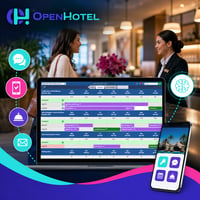
An integrated hospitality platform brings critical hotel functions together into a connected operational environment.
Instead of managing multiple disconnected systems, teams work from a shared foundation. For example, within OpenHotel:
Reservations flow directly into the Property Management System. "A room sells on Expedia. Inventory updates automatically across booking channels, reducing the risk of overbooking and eliminating manual updates." The Booking Engine, PMS, and Channel Manager work together to maintain availability and distribution.
"A guest requests early check-in via SMS. Because communication is connected to the reservation record, the front desk immediately sees the request and can coordinate with housekeeping." Guest Messaging keeps communication connected to reservations and guest records, improving the interdepartmental communication too.
"An owner managing multiple responsibilities wants a quick snapshot of occupancy, ADR, and pickup trends. Instead of gathering reports from multiple systems, the information is available in a centralized reporting environment." Enterprise reporting provides visibility across the business without requiring information from multiple sources.
When systems are designed to work together, hotel teams spend less time moving data and more time making decisions.
The goal isn't simply having more technology. It's having technology that supports the way hotels actually operate.
The Bottom Line
Technology should reduce complexity, not create it. For many independent hotels, the greatest opportunity isn't adding another tool.
It's creating a connected operational environment where reservations, revenue, communication, reporting, and guest management work together. Because when systems work together, teams work better.
And when teams work better, guests notice.